
Free Shipping For Orders Over $40

0

Your Cart is Empty

How To

How to Deploy TrollTrue Baits

The bait is rigged. Everything that happens between here and the spread decides whether it swims the way it's supposed to — and most of it takes about a minute.

Home  /  How To  /  Deploying the Baits

Start here

What you're aiming for

A TrollTrue bait is a swimming bait, not a skipping one. That's the whole point of the design, and it's the standard everything below is measured against.

A correctly deployed ballyhoo swims a foot or two under the surface with natural action in the tail. It should not be dead-sticking through the water like a piece of driftwood, and it should not be spinning — a spinning bait twists your leader, catches nothing, and tells you something is wrong with the rig or the speed.

The spec

4–8 knots. One to two feet deep. Tail working, body straight, no spin. If your bait looks like that beside the boat, it will look like that in the spread.

The method

Getting the bait into the spread

Four steps, in order. The first one is the one people skip, and it's the one that saves you re-rigging later.

Step 01

Watch it beside the boat first

Alt image

Find clean water alongside the boat where you can actually see the bait.

Troll it beside the boat and watch it for a full minute before it goes anywhere near the spread. Look for a patch of clean water where you can see what it's doing.

You're checking one thing: is it swimming the way it does in the video? Natural action on the tail, running straight, no spin. Sixty seconds here beats discovering a problem two hundred yards back.

Step 02

Adjust before you drop back

Alt image

Three things to check — speed, the bait itself, and how the lure is seated.

Boat speed. Anywhere from 4 to 8 knots can be right. Adjust it until the action is best and let the bait tell you where it wants to be. More on this in how fast to troll offshore.

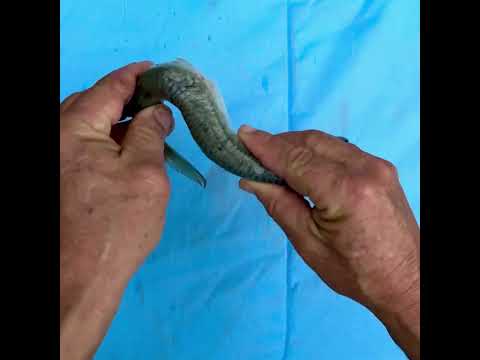
The ballyhoo. Make sure it's thoroughly thawed, and limber it up if it isn't moving freely. A stiff bait cannot swim.

The lure. Check it's well seated on the head. If you're still getting used to TrollTrue, this is a reasonable moment to pin it in place.

Step 03

Drop it back under tension

Thumb on the spool the whole way back.

Once you're happy with the action, drop the bait back — keeping tension on the line the entire time.

Do not free spool it. This is the single most common way to undo everything you just set up. Without line tension the bait tumbles, and a tumbling bait unseats the lure. You won't know it happened until you check the bait.

Step 04

Set its position in the spread

Position is what keeps it swimming rather than skipping.

Now place it. The goal is the same as it was beside the boat: a bait that stays in the water and swims, rather than one that climbs out and skips across the surface.

Skipping is not just untidy — every skip is a chance for the lure to come off the ballyhoo's head. If it's skipping, the next section is for you.

Troubleshooting

If the bait is skipping

Work through these in order. Each one lowers the bait's angle of attack on the water, and usually the first is enough.

Drop it further back

More line out means a shallower angle from rod tip to bait. The simplest fix and the first one to try.

Lower the angle of entry

Clip the line to the gunnel with a release, or take it out of the outrigger position. Both pull the bait down into the water rather than up out of it.

Slow down

You have room between 4 and 8 knots. Coming down a knot often settles a bait that's riding high.

Pin the lure

When seas are rough enough that nothing keeps the bait down, stop fighting it and secure the lure to the ballyhoo.

Still stuck?

Talk to someone who fishes these

Customer service is available 24/7. Call or text and we'll walk you through it — send a photo or a short video of the bait running and we can usually spot it straight away.

Call or Text 1-910-995-2485

Keep reading

More how-to guides

The full rigging sequence, from bait selection to a finished, straight-tracking ballyhoo.

Building the rigging yourself — leader, hooks, crimps and the assembly order.

When to pin the lure to the ballyhoo, when to leave it free, and how to do it.